
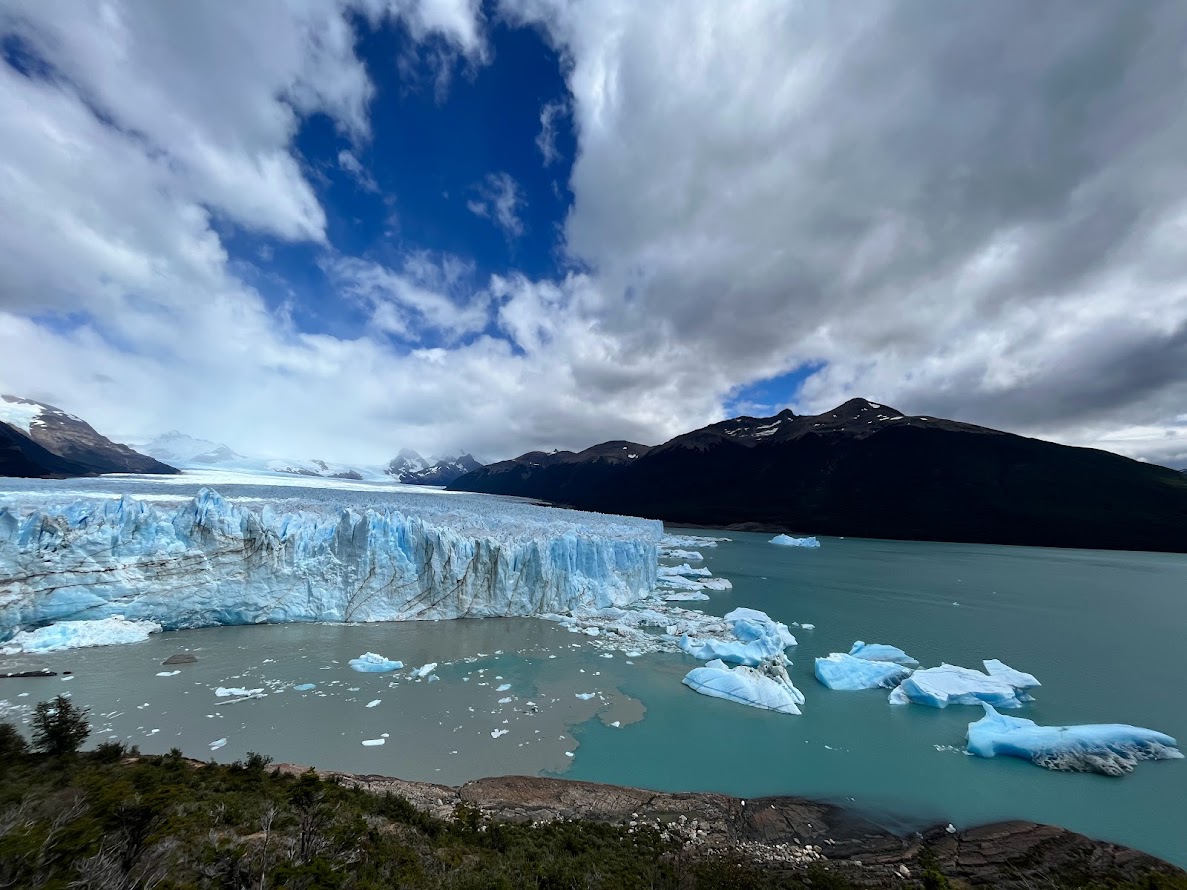
Five leading environmental organizations based in Argentina – Greenpeace Argentina, Fundación Ambiente y Recursos Naturales (FARN), Aves Argentinas, Asociacion de Abogades Ambientalistas y Colectivo de Acción por la Justicia Ecosocial, and Jóvenes por el Clima warn that during the extraordinary sessions of Congress starting February 2nd, headway will be made on the amendment to the Glacier Law. These organizations warn that this initiative, which has already obtained an express ruling in the National Senate Environment Comission, represents a serious setback in the protection of glaciers and the periglacial environment, and they demand that no changes be made that weaken the current law.
“Modifying the Glacier Law in the midst of a climate and water crisis means reducing the protection of strategic freshwater reserves for Argentinians and putting the water security of more than 7 million people at risk. Glaciers and the periglacial environment are not ‘worthless ice’: they regulate river flows, sustain watersheds in drought conditions, and play a key role in the face of rising temperatures,” said Matías Arrigazzi of the Greenpeace Argentina team.
Argentina has almost 17,000 glaciers inventoried in 12 provinces, which feed 36 watersheds covering more than one million square kilometers. Glaciers and the periglacial environment represent strategic water reserves for the present and future populations.
“Periglacial environments are not empty territories: they are home to a wide variety of life forms that perform key ecological functions and sustain delicate environmental balances. Many of these species and natural processes transcend provincial political boundaries; nature does not recognize administrative limits. Today, these environments and the biodiversity they shelter are seriously threatened, and their protection requires a comprehensive, federal, and science-based approach,” said Hernán Casañas, Executive Director of Aves Argentinas.
The organizations also warn that the proposed amendment is unconstitutional. It violates Article 41 of the Argentine Constitution, the precautionary and prevention principles established in the General Environmental Law (Nº26.675), and the principle of environmental non-regression recognized in the Escazú Agreement, ratified in Argentina by law. The initiative transfers to the provinces the definition of which glaciers and which portions of the periglacial environment should be protected, breaking the national and uniform nature of minimum environmental standards and enabling unequal criteria for water systems that do not recognize political boundaries. This takes away decision making power from the Argentine Institute for Snow Studies, Glaciology, and Environmental Sciences (IANIGLA, for its initials in Spanish), the experts in this field.
“The proposed reform is highly regressive and unconstitutional, and will ultimately erode the very foundations of legal certainty that it seeks to promote. The Glacier Law does not need to be reformed; it simply needs to be enforced,” said Andrés Nápoli, Executive Director of FARN.
“Approving this amendment means leaving our strategic freshwater reserves unprotected, replacing technical and scientific criteria with political and economic pressures, with irreversible consequences for millions of Argentines for decades to come,” said Mercedes Pombo, co-founder of Jóvenes por el Clima.
Likewise, leaving the “relevant water value” of glaciers and periglacial environments to provincial administrative assessment is scientifically incorrect. These areas store large volumes of ice at depth and play an essential role in water regulation. Their destruction implies the irreversible loss of water that cannot be recovered and opens the door to a repeat of known episodes of contamination, such as the spills recorded in mining projects in mountainous areas.
“What is at stake is water. There are plans to sacrifice glaciers that are thousands of years old, which provide water for life, work, and agriculture, for large transnational mining projects. But these rivers nourish a large part of our country,” said Enrique Viale, President and Founder of the Argentine Association of Environmental Lawyers.
The Glacier Law is a pioneering piece of legislation worldwide: it declares glaciers and the periglacial environment to be public assets and strategic water reserves. It was ratified as constitutional by the Supreme Court and has proven effective in protecting these areas from the advance of more than 40 extractive projects. Weakening it will not lead to sustainable development, but rather to greater climate vulnerability, water loss, social impacts, and rising economic costs.