
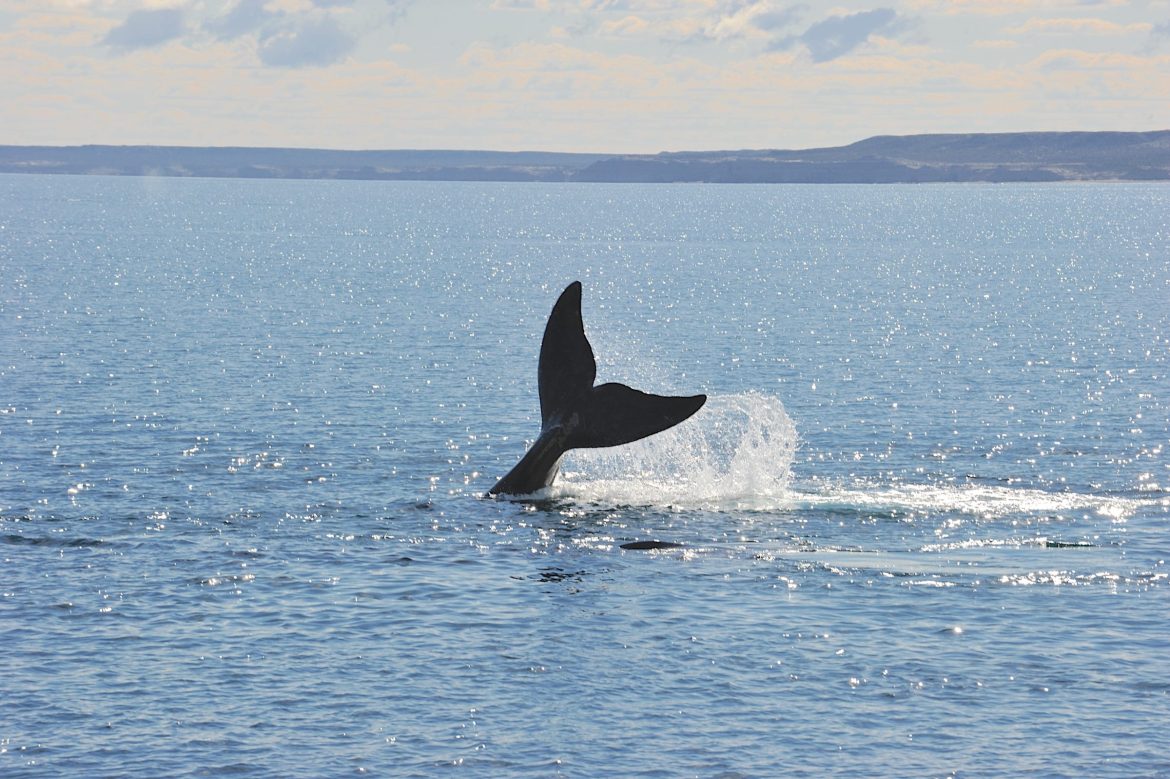
By the 1920s, the southern right whale’s estimated global population had fallen to around 300. Since then, a range of conservation efforts, including action by the International Whaling Commission, have aimed to reverse the decline. Today, southern right whale populations off Argentine Patagonia are showing signs of recovery, with the “Blue Gulf” of San Matías emerging as a key breeding and calving site. But a new threat is looming.
The San Matías Gulf is also becoming central to national plans to export liquefied natural gas (LNG). As extraction ramps up inland at the Vaca Muerta oil and gas field – one of the world’s largest shale deposits – exports are accelerating under the pro-extraction presidency of Javier Milei, who has called Argentine LNG “the largest investment in the history of Argentina.”
Cristian Fernández, legal coordinator for FARN, warns of the project’s emissions risks: “The environmental impact study omits a serious analysis of emissions, including carbon dioxide, methane, and volatile organic compounds such as benzene.” He argues the San Matías Gulf is being treated as a “sacrifice zone” in the name of economic development.
So far, four projects tied to the LNG export plan have been approved by the national government. The largest is a nearly 500-kilometer oil pipeline known as Vaca Muerta Oil Sur. YPF president and CEO Horacio Marín has described it as “the largest infrastructure project in the country.”
Two floating vessels from the Norwegian company Golar LNG are also expected to operate off Argentina’s coast to liquefy gas. As an alternative to permanent onshore facilities, these ship-based units, 300-400 meters long and 112 meters high, function as offshore processing plants. According to Southern Energy, the first vessel is scheduled to begin operations in 2027, followed by a second in 2028. Together, they are expected to process about 17% of Argentina’s current gas production.