
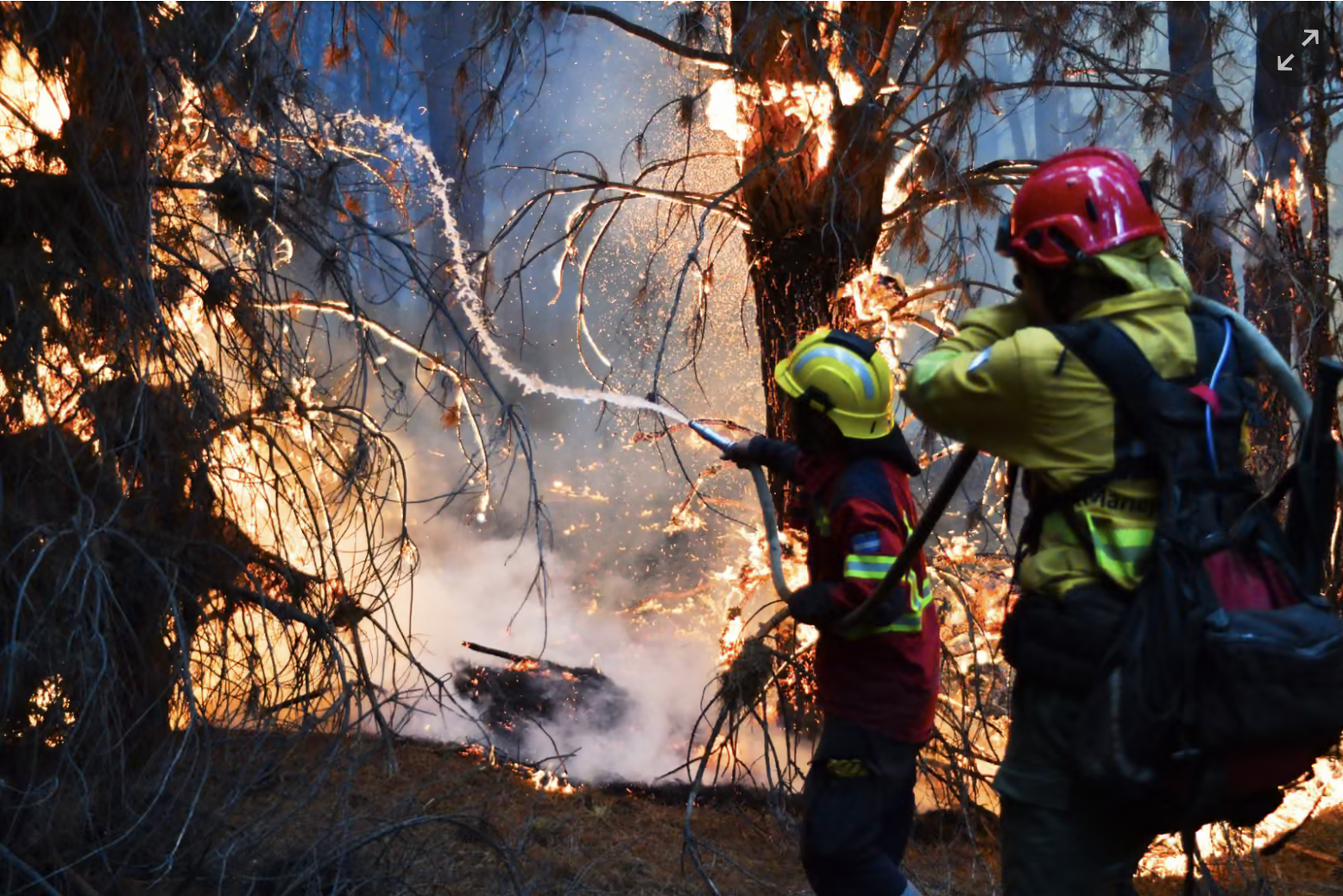
Wildfires in Argentine and Chilean Patagonia have burned more than 90,000 acres of land since January 5. In Chile alone, at least 18 people have been killed this month as a result of the fires. While efforts to contain the flames are ongoing, outbreaks can rapidly reignite with a single gust of wind or heatwave.
“There was a confluence of many climatic factors,” said Andrés Nápoli, director of the Environment and Natural Resources Foundation (FARN). “This year has not had enough snowfall; there are low humidity levels and a high accumulation of combustible elements in the forest” — a reference to monoculture pine plantations, which act as “powder kegs.”
Compounding these conditions, Milei’s government defunded the forestry law that allocated resources to protect native forests. Firefighter salaries have fallen below $500 a month, under Argentina’s poverty line for a family of four. As a result, communities have stepped in, creating makeshift firebreaks with chainsaws, rakes, hoses, and other everyday tools. Firefighters continue to work on the front lines, often taking on second jobs just to survive.
Conspiracy theories have circulated claiming that Israeli citizens are responsible for the fires or, as suggested by Argentina’s president Javier Milei, that they were deliberately started by the Indigenous Mapuche people in Argentina and Chile. The prosecutor investigating the case, Carlos Díaz Mayer, confirmed that accelerants were found at the site where the fire likely began, but there is no evidence to support these claims.