
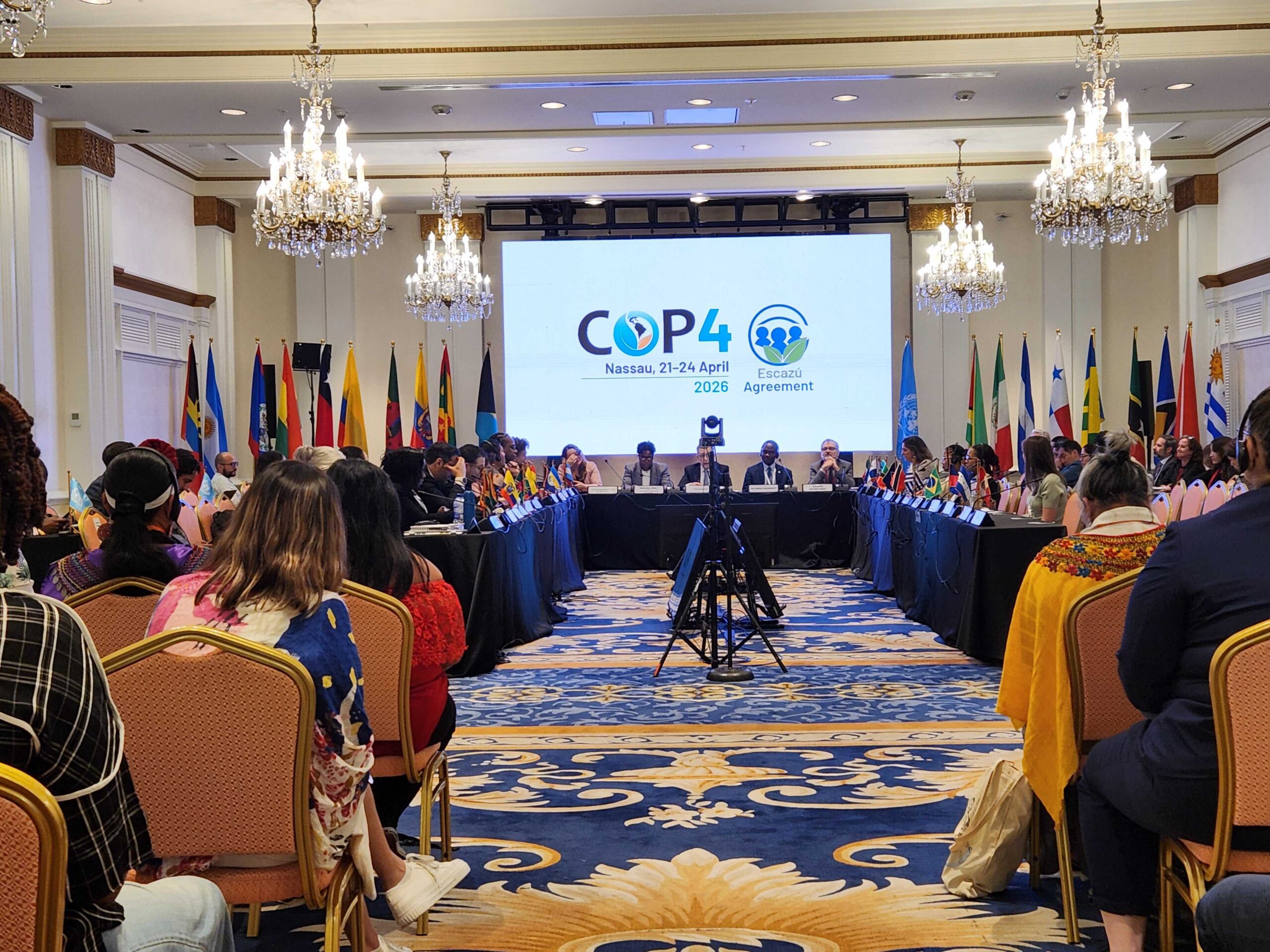
The fourth Conference of the Parties to the Escazú Agreement (Escazú COP4), held from April 20 to 24 in Nassau, Bahamas, has concluded. The Agreement is the first legally binding regional treaty in Latin America and the Caribbean focused on “environmental democracy”: access to environmental public information, public participation in environmental decision-making, and access to justice in environmental matters.
It is also the first treaty in the world to recognize the need to protect environmental defenders explicitly. This year marked the first time the conference was held in the Caribbean, a region that represents more than half of the 15 countries that have ratified the Agreement so far.
In this edition, discussions focused on participation, gender, and access to information. A key development was the proposal of a pollutant emissions registry covering soil, air, water, and subsoil. This registry is currently in an early stage in Argentina and in countries such as Brazil, Belize, Jamaica, Uruguay, Peru, and Costa Rica. It represents a first step toward generating standardized, publicly accessible data that can improve transparency and support evidence-based decision-making. Expert groups will continue working toward regional alignment of the registry ahead of COP5, scheduled for 2028.
A new pollutant emissions registry
Pollutant Release and Transfer Registers (PRTRs) are public information systems that collect, process, and publish verifiable data on the release of pollutants into air, water, soil, and subsoil, as well as on the transfer of waste and substances outside their site of origin for disposal, treatment, recycling, or recovery (art. 6.4 of the Escazú Agreement). In practice, these systems often rely on mandatory reporting by industries, making them a key transparency tool.
Their inclusion highlights the importance of independent monitoring of pollution, particularly in regions where environmental oversight has historically been limited.
In Argentina, this is closely tied to the hydrocarbon sector – particularly large-scale extraction projects such as those in Vaca Muerta. The data generated by these registries can serve as a baseline for designing public policies to reduce emissions and establish limits on greenhouse gases such as methane. They are also critical for monitoring air and water quality in areas where hydrocarbon extraction produces high environmental impacts and harm to human health.
Criminalization of environmental defenders
At the heart of the Escazú Agreement is the protection of environmental defenders; individuals and communities who advocate for environmental protection and are often exposed to threats or violence. Throughout the conference, defenders from across the region spoke out, denouncing persecution, criminalization, and stigmatization.
From Argentina, Itatí Brida, a member of the Uspallata Water Assembly, denounced the criminalization of social protest in the province of Mendoza. She referred specifically to the detention of environmental defenders opposing the San Jorge copper mining project, a controversial initiative criticized for its potential environmental impacts.
She also denounced violations of public participation in the public hearing held during the debate on reforms to the glacier protection law – legislation designed to safeguard key freshwater reserves – where more than 100,000 registered participants were denied meaningful participation.
Implementation of the Agreement in Latin America and the Caribbean
Across Latin America and the Caribbean, eight countries (Argentina, Belize, Chile, Ecuador, Mexico, Panama, Saint Lucia, and St. Kitts and Nevis) have developed national roadmaps for implementing the Escazú Agreement. These roadmaps typically outline legal reforms, institutional responsibilities, and timelines for ensuring access to information, participation, and justice. Colombia is currently developing its roadmap, while other signatory countries have yet to begin the process.
At a side event organized by the Escazú Network and the Escazú Observatory in Argentina, experts discussed progress and challenges in implementation.
- Franklin Falconi (Ecuador) highlighted the inclusion of civil society and academic actors in shaping national roadmaps.
- Valeria Enderle (Argentina) noted that while Argentina has both a roadmap and an implementation plan, current conditions are marked by regulatory setbacks, including weakened environmental protections. She emphasized the work carried out by the Meulen project in monitoring environmental regressions within the framework of the Escazú Observatory.
- Karol Sanabria (Colombia) highlighted the participatory dialogue through which Colombia’s roadmap is being developed, as well as the need to establish follow-up mechanisms with concrete actions, responsible actors, and financial resources.
- Felix Wing (Panama) stressed the need to translate legal rights into enforceable public policies.
Daniel Barragán (Ecuador), a member of the Escazú Now Network and moderator of the event, explained that roadmaps are not set in stone and must adapt to new circumstances.
After three days of negotiations, Cristian Fernández, coordinator of the Legal Department at the Environment and Natural Resources Foundation (FARN), summarized:
“In times of regional and global leaders who deny climate change, and in the midst of a crisis of multilateralism and international cooperation, spaces like the Escazú COP are essential for coming together, engaging in dialogue, exchanging perspectives, and remembering the reasons why we defend every day the rights to access public information, to participate in decisions that may affect the environment and ecosystems, and to claim these rights through environmental justice. Likewise, meeting defenders from different parts of the region inspires us to continue fighting for a more just and supportive environmental democracy.”