
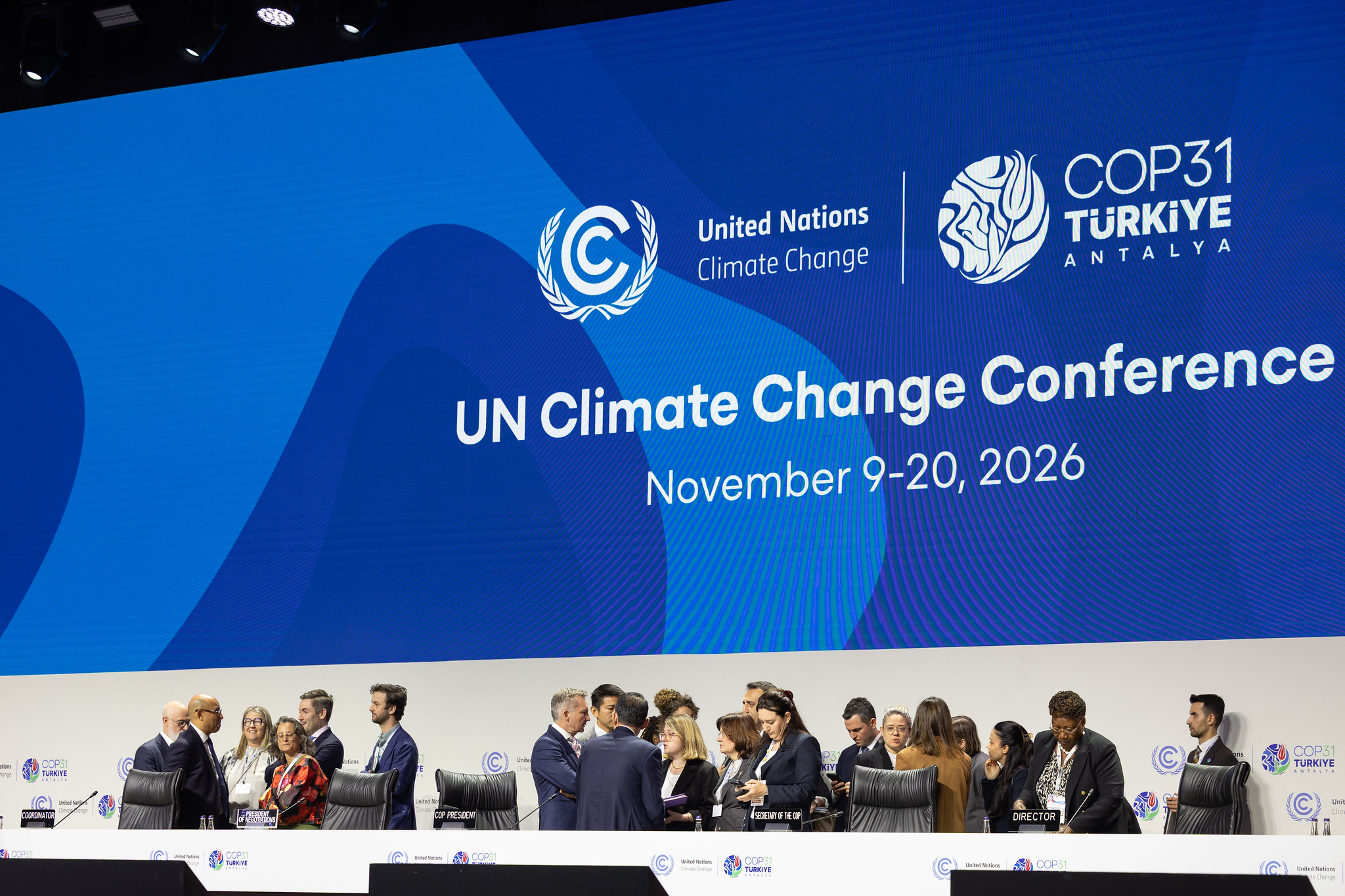
The Antalya summit ended without an overarching political agreement, without a roadmap to phase out oil, gas, and coal, and without a plan to meet the adaptation finance goal. The decision on just transition maintains the mandate agreed upon in Belém, but postpones key definitions for operationalizing the mechanism until 2027.
COP31 was meant to take concrete steps to implement climate commitments. However, in Antalya, governments once again postponed decisions that were already urgent in Belém: how to reduce dependence on fossil fuels, how to finance adaptation, and how to ensure that countries, communities, and workers receive support to carry out a just transition. Every delay has concrete consequences for those actively facing the impacts of climate change.
While Global North countries continue to fail to agree on how they will meet the goal of tripling adaptation finance, military spending reached a record high in 2025, and governments continue to allocate resources to sustain fossil fuel expansion. The United States government, the largest historical emitter, was once again absent, with no official representation at the summit. In Argentina, Javier Milei’s administration cuts resources for environmental and climate policy while offering tax benefits to large-scale extractive projects linked to minerals, oil, and gas. These decisions reduce the capacity to prevent loss and damage and shift the costs onto those with the fewest resources and lowest capacity to cope with them.
Just transition: the Belém mandate stands, but the mechanism will have to wait
COP31 extended the Just Transition Work Programme for three years and agreed to move forward in stages toward operationalizing the Just Transition Mechanism. Definitions regarding its functions, governance, and mode of operation will continue to be negotiated in 2027, with a view to reaching an agreement at COP32 in Addis Ababa.
During the first week of this COP, the dispute over the scope of the mechanism became visible. The European Union and other Global North countries resisted proposals to endow it with a structure capable of coordinating and facilitating concrete support, and, in the final stretch, Global South countries defended the continuity of the mandate against a text that threatened to close off the possibility of building an actionable mechanism.
The mechanism must facilitate access to finance that neither generates further debt nor supports false solutions, in addition to strengthening cooperation and technical assistance, and ensuring that communities and workers play a leading role in decision-making. This implies supporting both regions dependent on oil, gas, or coal and territories affected by the extraction of minerals considered critical for the transition.
The discussion on minerals reached the Antalya drafts, but language seeking to protect human rights throughout those value chains was left out of the final outcome. This is a particularly relevant shortfall for Latin America, where rising demand for minerals such as lithium intensifies pressure on water, high-Andean wetlands, and the territories inhabited by local communities and Indigenous Peoples.
The Antalya Pact was left without consensus
Turkey, holding the COP presidency, and Australia, leading the negotiations, had the responsibility of building an agreement that would provide continuity to what was decided in Dubai and Belém. The two proposals comprising the so-called Antalya Pact reached the final plenary without an explicit reference to phasing out fossil fuels. Instead, the draft proposed scaling up carbon capture, utilization, and storage, and offered no clear plan to meet the goal of tripling adaptation finance. The Dubai commitment to transition away from fossil fuels remains in force, but in Antalya there was a lack of agreement on how to put it into practice.
Defending multilateralism also means defending the right of countries most exposed to the climate crisis to question texts that weaken previous commitments and to demand that consensus be built with transparency and participation. In this regard, at COP31, civil society organizations questioned the lack of ambition in the texts, and, in the plenary, Panama, Vanuatu, the Marshall Islands, the European Union, and other countries objected to the proposals for reasons that included the lack of a science-aligned response, the omission of fossil fuels, and insufficient finance. The two overarching decisions were left unapproved.
Argentina: a new climate target without an implementation roadmap
Argentina participated in Antalya and arrived with a new climate contribution, submitted a few days before the summit began. NDC 3.0 sets the same net emissions ceiling for 2030 and 2035, at 275 million tons of carbon dioxide equivalent. The national government keeps the External Advisory Council (CAE) of the National Climate Change Cabinet (GNCC) inactive while simultaneously promoting export infrastructure that deepens dependence on Vaca Muerta. According to the National Climate Action Observatory (ONAC), nine out of ten evaluated climate commitments are off track for compliance.
In Argentina, advancing toward a just transition requires halting the expansion of fossil fuel infrastructure, reducing emissions at the source, and allocating resources to prevention and adaptation. It also requires restoring participatory spaces so that communities, workers, and vulnerable groups can influence the policies affecting their territories.
FARN at COP31
During COP31, we followed the negotiations and participated in advocacy spaces with civil society organizations. FARN’s delegation, made up of Camila Mercure, Climate Policy Coordinator, and Ariel Slipak, Research Coordinator, brought information to Antalya on the impacts of liquefied natural gas (LNG) expansion in Argentina, the challenges of a just phase-out of fossil fuels, and the need to guarantee rights across the mineral value chains. In their interventions, Mercure and Slipak emphasized the need to build alternatives to the ecological and climate crisis rooted in participatory dynamics and a just socio-ecological transition.
“Towards a Just Energy Transition: Breaking the Fossil Lock-in and Building Quality Jobs”
We co-organized a panel alongside Deutsche Umwelthilfe (Germany) and other organizations at the Just Transitions Pavilion. During the event, Milena Pressentin, Energy and Climate Expert (DUH), and Ariel Slipak (FARN) gave presentations on how various European Union policies contradict a just energy transition and already have severe socioeconomic and biodiversity impacts, as is occurring in the San Matías Gulf.
“From Santa Marta to GST2: Delivering the Transition Away from Fossil Fuels”
At an official side event, alongside the International Institute for Sustainable Development (IISD), the Institute for Socioeconomic Studies (INESC), the Government of the Netherlands, South Centre, and Transforma, we discussed how to put the fossil fuel phase-out into practice.
The event featured two segments: a high-level segment with the participation of Maina Talia (Minister of Environment of Tuvalu), Jan Versteeg (Climate Envoy of the Netherlands), Ana Toni (Executive Director of COP30), Philip Nugent (Director of the Department of Climate, Energy and Environment of Ireland), Jean-Luc Crucke (Minister of Mobility, Climate and Ecological Transition of Belgium), and Javier Palummo (Special Rapporteur on Economic, Social, Cultural and Environmental Rights of the Inter-American Commission on Human Rights); and another with civil society contributions, where Ariel Slipak (FARN) addressed the issue of phasing out fossil fuel subsidies, stressing that while institutions like the IMF and Global North countries demand that Global South countries abruptly eliminate subsidies that enable access to energy or home heating, they remain silent on large tax exemptions that directly benefit oil and gas companies.
“From Climate Commitments to Implementation: A Methodology for Independent Climate Action Monitoring”
Camila Mercure (FARN) moderated a panel organized by Sustentabilidad Sin Fronteras, the National University of San Martín (UNSAM), and EcoNews. Nasha Cuello Cuvelier presented the methodology of the National Climate Action Observatory (ONAC), developed with the support of evaluating organizations, including FARN, to assess compliance with climate commitments through verifiable indicators. Together with Rodrigo Rodríguez Tornquist and Lucía Lopreiato, they discussed how to use monitoring results to identify implementation gaps, guide public policy proposals, and strengthen journalistic coverage and accountability in Argentina.
“Fossil Fuel Subsidy Phase Out – What works for campaigners”
The process of phasing out fossil fuels involves a discussion on pathways to eliminate economic subsidies for oil and gas activities. To advance this effort, the Coalition on Phasing Out Fossil Fuel Incentives Including Subsidies (COFFIS) was created during COP28 under the leadership of the Government of the Netherlands. This coalition is monitored by civil society organizations grouped in the COFFIS Observatory, which works to ensure that this subsidy phase-out adopts a rights-based approach without increasing barriers to energy access or energy poverty. Within the framework of the Peoples’ Climate Summit, we organized a panel discussion on pathways for subsidy phase-out alongside the COFFIS Observatory, United for Climate Justice, and Oil Change International. The panel featured Paolo Destilo (COFFIS), Laurie van der Burg (Global Public Finance Lead, Oil Change International), and Ariel Slipak (FARN).
On this same topic, we also organized a working workshop inside the COP convention center alongside Recourse, MenaFEM, and Alternative Law Collective entitled “A just exit from fossil fuel subsidies.”
“Electrification and Transition Minerals: Putting Rights at the Center”
At this official side event, co-organized by FARN, Camila Mercure posed a question to guide the debate on electrification: where do the minerals come from, and whose transition do they contribute to? She pointed out that Latin America exports raw materials that help decarbonize other economies, while much of the social and environmental impacts of extraction remain in the territories. Drawing on the case of lithium in the salt flats and high-Andean wetlands of Argentina, Bolivia, and Chile, she emphasized the need to protect water and ecosystems, guarantee community participation from the outset, and respect the right of Indigenous Peoples to free, prior, and informed consent.
“Fossil-free prosperity: Aligning just transition and adaptation in Latin America”
At the Global Futures Pavilion in the Blue Zone, Camila Mercure (FARN) participated alongside María Noel Dussort and Carolina Passet (Argentina 1.5) and Nicole Makowski (GFLAC), moderated by Joel González (Argentina 1.5). Mercure raised the need to jointly address the phase-out of fossil fuels and climate change adaptation. From a just transition perspective, she stressed that both agendas must start from the needs of the territories and include the participation of communities and workers who are already facing the impacts of the climate crisis and whose economies and livelihoods will be affected by the energy transition.
“Cross-movement Dialogues: Tax Justice to Bridge the Finance Gap”
We co-organized a gathering at the SDG Pavilion together with GFLAC, GI-ESCR, Latindadd, the Rosa Luxemburg Foundation, Oxfam, Climate Action Network (CAN), and Tax Justice Network. Designed as a participatory roundtable between the climate justice and tax justice movements, the space addressed the link between climate negotiations and the process toward a UN Framework Convention on International Tax Cooperation, exploring how fairer global tax rules can disincentivize polluting activities and mobilize public resources at scale for just transition, adaptation, and loss and damage. The exchange featured opening remarks by Javier Palummo (REDESCA-CIDH), Ezequiel Steuermann (GI-ESCR), Carola Mejía (Latindadd), Mariana Paoli (Oxfam), and Sandra Guzmán (GFLAC).